
Split Leaf Philodendron vs Monstera: How to Tell Them Apart and Grow Each One
Walk into any plant shop and you’ll see large tropical plants with dramatic split leaves labeled “split leaf philodendron.” Except many of them aren’t philodendrons at all, they’re Monsteras. The names get used interchangeably, garden centers mislabel plants constantly, and even experienced gardeners mix them up.
Here’s the confusion: the plant commonly called “split leaf philodendron” (Monstera deliciosa) isn’t actually a philodendron. There is a true split-leaf philodendron (Philodendron bipinnatifidum, now renamed Thaumatophyllum bipinnatifidum), but most people calling something a “split leaf philodendron” are actually looking at a Monstera.
Both are beautiful, both have split leaves, both are tropical, and both make excellent houseplants or outdoor plants in warm climates. But they’re different plants with different care needs and different growth habits. Let’s clear up the confusion and help you identify what you actually have or what you’re about to buy.
The Quick Identification Guide
Monstera deliciosa (Swiss Cheese Plant):
- Leaves have holes (fenestrations) AND splits that extend to the leaf edge
- Leaves are heart-shaped at the base
- Climbing vine that needs support
- Aerial roots grow from stems
- Smooth, lighter green stems
Philodendron bipinnatifidum / Thaumatophyllum bipinnatifidum (Tree Philodendron):
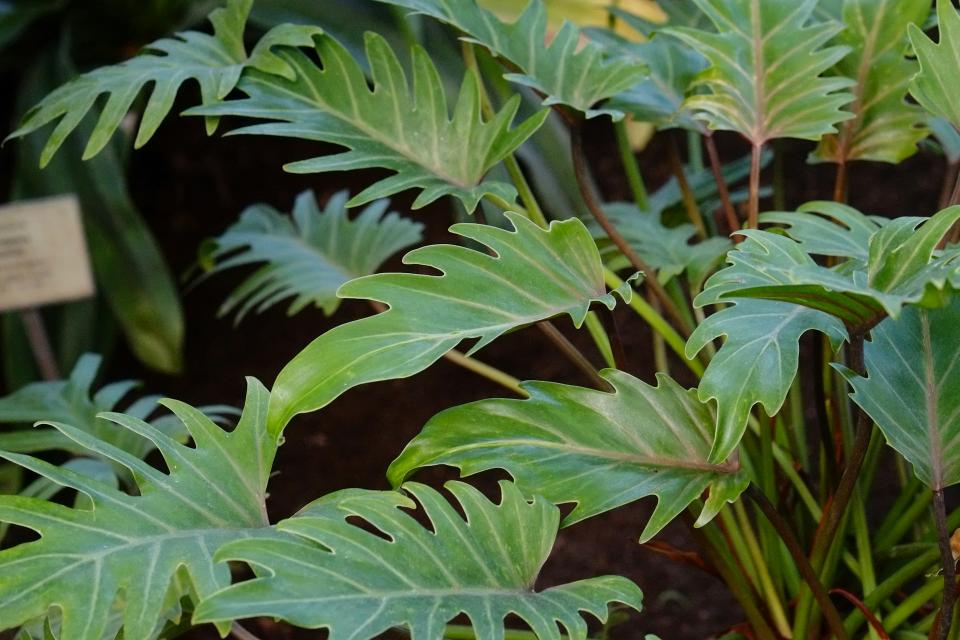
- Leaves have deep splits (lobes) but NO holes in the middle of leaves
- Leaves are more wavy/ruffled at edges
- Self-heading (grows upward from central point, doesn’t climb)
- Thick trunk develops as it matures
- Reddish-brown or burgundy stems
The easiest tell: Look for holes in the middle of mature leaves. Holes = Monstera. No holes, just splits to the edge = True philodendron.
Monstera Deliciosa: The “Swiss Cheese Plant”
Common names: Split leaf philodendron (incorrect but common), Swiss cheese plant, fruit salad plant, Monstera
Scientific name: Monstera deliciosa
Family: Araceae (same family as true philodendrons, which is why confusion exists)
Native to: Southern Mexico and Central America rainforests
Growth habit: Climbing vine that uses aerial roots to attach to trees. In homes, it leans/climbs and needs support.
Mature size:
- Indoors: 6-10 feet tall with support
- Outdoors (Zones 10-11): 15-30 feet tall, 8-15 feet wide
Leaf characteristics:
- Heart-shaped base
- Deep splits extending to leaf edge
- Oval holes (fenestrations) throughout the leaf
- Can grow 2-3 feet long on mature plants
- Young plants have solid leaves, splits develop as plant matures
Why it’s called Swiss cheese: The holes in mature leaves resemble Swiss cheese
Edible fruit: Produces edible fruit (tastes like pineapple-banana) but only on mature outdoor plants in tropical climates. Takes 12+ months to ripen. Unripe fruit is toxic.
Growing Monstera Deliciosa
Light requirements:
- Bright indirect light indoors
- Tolerates low light but grows slowly with smaller leaves
- Outdoors: partial shade to filtered sun (Zone 10-11)
- Direct sun indoors burns leaves; outdoors it adapts if acclimated gradually
Temperature:
- Ideal: 65-85°F
- Minimum: 50°F (growth stops, leaves may yellow)
- Dies below 32°F
- Zones 10b-11 for year-round outdoor growing
Watering:
- Water when top 2-3 inches of soil are dry
- Typically once per week indoors
- More frequent in bright light or warm temperatures
- Less frequent in low light or cool temperatures
- Overwatering causes yellow leaves and root rot
Humidity:
- Prefers 60%+ humidity but tolerates average home humidity (40-50%)
- Benefits from occasional misting or pebble tray
- Brown leaf edges indicate low humidity
Soil:
- Well-draining potting mix
- Mix: 2 parts potting soil, 1 part perlite, 1 part orchid bark or coco coir
- Must have drainage holes in container
Fertilizing:
- Balanced liquid fertilizer (20-20-20) diluted to half strength
- Every 4-6 weeks during growing season (spring-fall)
- Monthly or skip entirely in winter
- Yellow leaves with green veins = nutrient deficiency (usually nitrogen)
Support:
- Needs moss pole, trellis, or stake as it grows
- Aerial roots attach to support and help plant climb
- Without support, plants sprawl or lean awkwardly
Pruning:
- Prune to control size or shape anytime
- Cut just above a leaf node
- Use clean, sharp scissors or pruners
- Cuttings can be propagated in water or soil
Propagation:
- Stem cuttings with at least one node and one leaf
- Root in water (change water every 3-4 days)
- Roots develop in 2-4 weeks
- Transplant to soil when roots are 2-3 inches long
Common problems:
- Yellow leaves: overwatering or nutrient deficiency
- Brown edges: low humidity or underwatering
- No leaf splits: insufficient light or young plant
- Leggy growth: too little light
Philodendron Bipinnatifidum: The True “Split Leaf Philodendron”
Common names: Split leaf philodendron, tree philodendron, lacy tree philodendron, selloum
Scientific name: Philodendron bipinnatifidum (recently reclassified as Thaumatophyllum bipinnatifidum, but most still use old name)
Family: Araceae
Native to: South America (Brazil, Argentina, Paraguay)
Growth habit: Self-heading (grows upward from a central trunk). Does not climb. Mature plants develop thick trunk.
Mature size:
- Indoors: 4-6 feet tall and wide
- Outdoors (Zones 9b-11): 8-15 feet tall, 10-15 feet wide
Leaf characteristics:
- Deeply lobed/split leaves
- NO holes in middle of leaves (this is key difference from Monstera)
- Wavy, ruffled edges
- Can grow 2-3 feet long
- Reddish-brown or burgundy stems/petioles
Growth pattern: Produces multiple leaves from central crown. Creates thick trunk with age. Never climbs or vines.
Growing Philodendron Bipinnatifidum
Light requirements:
- Bright indirect light to partial shade
- More tolerant of low light than Monstera
- Outdoors: partial to full shade (Zone 9b-11)
- Adapts to various light conditions
Temperature:
- Ideal: 65-80°F
- Minimum: 55°F (growth slows below this)
- Tolerates brief dips to 35-40°F (more cold-hardy than Monstera)
- Dies at hard freeze (28-32°F)
- Zones 9b-11 for outdoor growing; Zone 9a with protection
Watering:
- Water when top 2-3 inches of soil dry out
- Slightly more drought-tolerant than Monstera once established
- Outdoors: may only need supplemental water during drought
- Yellowing leaves often indicate overwatering
Humidity:
- Tolerates lower humidity than Monstera
- Average home humidity (40-50%) is fine
- Misting optional but appreciated
Soil:
- Well-draining potting mix
- Less picky than Monstera about soil composition
- Standard potting soil with added perlite works well
Fertilizing:
- Balanced fertilizer (20-20-20) at half strength
- Every 4-6 weeks spring through fall
- Reduce or skip in winter
- Light feeder compared to many tropicals
Support:
- Does NOT need support (major difference from Monstera)
- Self-supporting trunk develops naturally
- May need staking when young in high-wind outdoor areas
Pruning:
- Remove yellow or damaged leaves at base
- Cut old leaves to encourage new growth
- Prune to control size if it outgrows space
- Less pruning needed than Monstera
Propagation:
- Division of offsets (pups) from base of mature plants
- More difficult to propagate from cuttings than Monstera
- Seeds (rarely available)
Common problems:
- Yellow leaves: overwatering, cold temperatures, or age (normal for oldest leaves)
- Brown tips: low humidity, salt buildup, or fluoride in water
- Leggy growth: insufficient light
- Smaller leaves: nutrient deficiency or rootbound pot
Side-by-Side Comparison
| Feature | Monstera Deliciosa | Philodendron Bipinnatifidum |
|---|---|---|
| Leaf holes | Yes (fenestrations) | No |
| Leaf splits | Yes, to edge | Yes, deep lobes |
| Growth habit | Climbing vine | Self-heading/upright |
| Support needed | Yes (pole/trellis) | No |
| Aerial roots | Many, from stems | Few, mainly at base |
| Stem color | Green | Reddish-brown |
| Mature height indoors | 6-10 feet | 4-6 feet |
| Cold tolerance | Zone 10b+ | Zone 9b+ |
| Light needs | Bright indirect | Tolerates lower light |
| Humidity needs | Moderate-high | Low-moderate |
| Ease of propagation | Easy (stem cuttings) | Moderate (division) |
| Common name accuracy | Often called “split leaf philodendron” (wrong) | Actually is a split leaf philodendron |
Growing Outdoors in Warm Climates
Monstera deliciosa outdoors:
- Zones 10b-11 only (South Florida, Southern California coast, Hawaii)
- Plant in partial shade to dappled sunlight
- Provide sturdy tree or structure to climb
- Water 1-2 times per week; more in extreme heat
- May produce edible fruit after several years
- Can become invasive in tropical areas (check local regulations)
Philodendron bipinnatifidum outdoors:
- Zones 9b-11 (warmer parts of Texas, Florida, Arizona, California)
- Tolerates full shade to partial sun
- No support structure needed
- Drought-tolerant once established (water every 7-10 days)
- Develops substantial trunk and can become landscape focal point
- Less invasive than Monstera
Winter protection (Zone 9b):
- Mulch heavily around base before freezes
- Cover with frost cloth during cold snaps
- Plants may die back but return from roots if roots survive
Which One Should You Choose?
Choose Monstera deliciosa if:
- You want dramatic leaves with holes
- You have bright indirect light
- You’re willing to provide support structure
- You enjoy the climbing/trailing look
- You want easy propagation to share with friends
- You’re in Zone 10b+ for outdoor growing
Choose Philodendron bipinnatifidum if:
- You prefer self-supporting plants (no staking needed)
- You have lower light conditions
- You want a more compact growth habit
- You prefer the deeply-lobed leaf look without holes
- You’re in Zone 9b-11 for outdoor growing
- You want slightly easier care and more cold tolerance
Choose both if:
- You have space and enjoy variety
- You want to understand the differences firsthand
- You appreciate different tropical aesthetics
Common Buying Mistakes
Mistake 1: Buying a Monstera thinking you’re getting a non-climbing plant. Result: You’re surprised when it needs a pole and starts sprawling everywhere.
Mistake 2: Buying true Philodendron bipinnatifidum expecting leaf holes. Result: You wait for holes that will never develop because that’s not how this plant grows.
Mistake 3: Not checking mature size. Result: Your “small tropical plant” becomes 8 feet tall and dominates your living room.
Mistake 4: Assuming care is identical because they look similar. Result: One plant struggles because its specific needs aren’t being met.
How to avoid these: Ask the nursery for the scientific name. Look at mature plant photos online. Research care needs before buying.
The Toxicity Factor (Important for Pet Owners)
Both plants are toxic to cats, dogs, and humans if ingested.
Contains: Calcium oxalate crystals
Symptoms if eaten:
- Oral irritation, burning sensation
- Drooling, difficulty swallowing
- Vomiting
- Pawing at mouth (pets)
Not typically fatal but very uncomfortable.
Safety measures:
- Keep out of reach of pets and children
- Place on high shelves or in rooms pets don’t access
- Consider pet-safe alternatives if you have curious pets
Conclusion
The plant commonly called “split leaf philodendron” is usually Monstera deliciosa, a climbing vine with holes and splits in its leaves. The true split leaf philodendron is Philodendron bipinnatifidum, which has deeply lobed leaves without holes and grows upright without climbing.
Both are beautiful tropical plants suitable for homes and warm-climate gardens, but they have different growth habits and slightly different care needs. The easiest way to tell them apart: look for holes in the leaves. Holes mean Monstera. No holes mean true philodendron.
If you’re buying one, know which you’re getting so you can provide the right care and support (or lack thereof). If you already have one and aren’t sure which it is, look at the leaves and growth habit, the differences become obvious once you know what to look for.
Key Takeaways
- Monstera deliciosa has holes AND splits in leaves; Philodendron bipinnatifidum has only splits, no holes: this is the easiest identification method
- Monstera climbs and needs support; Philodendron grows upright and self-supports: fundamentally different growth habits
- Both are often called “split leaf philodendron” but only Philodendron bipinnatifidum actually is one: Monstera is frequently mislabeled
- Monstera prefers bright indirect light; Philodendron tolerates lower light better: choose based on your available light
- Both are toxic to pets and children if ingested: keep out of reach or choose pet-safe plants
- Monstera propagates easily from stem cuttings; Philodendron requires division: propagation difficulty differs
- Philodendron is more cold-hardy (Zone 9b vs 10b): survives in more areas outdoors
- Monstera needs 60%+ humidity; Philodendron tolerates 40-50%: Philodendron is more forgiving
- Look at stem color: green = Monstera, reddish-brown = Philodendron: another quick identification trick
- Check the scientific name at purchase to know exactly what you’re buying: common names are unreliable