
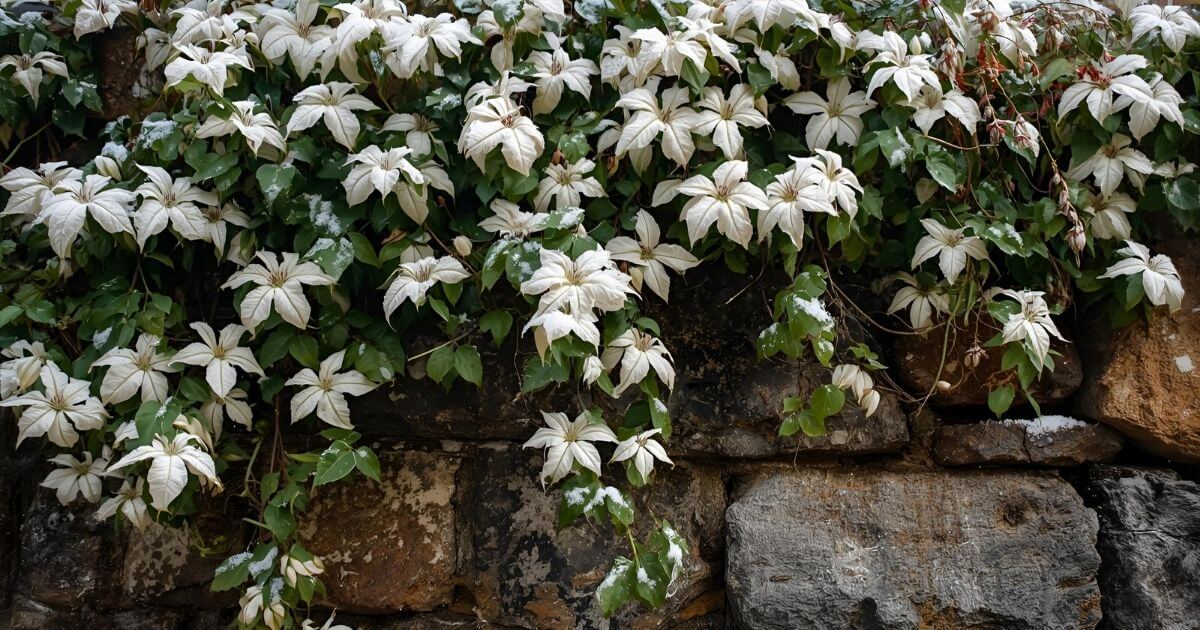
Winter Clematis: Varieties, Care, Pruning, and Cold Protection
Quick answer: Winter clematis usually refers to evergreen or semi-evergreen clematis that flower from late autumn into early spring, especially Clematis cirrhosa and its cultivars. They need a warm, sheltered position, fertile but well-drained soil, and protection from cold winds. Most belong to pruning Group 1, so established plants need little pruning; trim only after flowering in spring. These vines are best suited to mild climates, while gardeners in colder areas may need a protected container or a different early-flowering clematis.
A winter-flowering clematis can cover a wall or pergola with nodding cream flowers when most of the garden is quiet. The catch is that these plants are not simply cold-hardy versions of familiar summer clematis. Many come from Mediterranean or similarly mild climates and need careful siting to flower well.
The most useful question is not just “Does it bloom in winter?” It is whether the exact species fits your climate, available support, exposure, and pruning habits. This guide focuses on the winter-blooming types most gardeners are likely to encounter and how to keep them healthy.
Winter Clematis at a Glance
| Feature | Typical winter-flowering clematis |
|---|---|
| Main species | Clematis cirrhosa and cultivars; C. armandii flowers in late winter to spring |
| Bloom time | Late autumn through early spring, depending on species, cultivar, and climate |
| Foliage | Evergreen or semi-evergreen in suitable conditions |
| Light | Full sun to partial shade; warmer sheltered exposures usually improve flowering |
| Soil | Fertile, moist but well-drained |
| Pruning | Group 1: little regular pruning; prune only after flowering when needed |
| Support | Trellis, arbor, wires, fence, or mature shrub |
| Main limitation | Cold wind and severe winter exposure |
What Counts as a Winter Clematis?
“Winter clematis” is a practical garden label rather than one single plant. It usually describes clematis that flower before the main spring and summer display, often on shoots produced during the previous growing season.
The clearest example is Clematis cirrhosa, a Mediterranean evergreen or semi-evergreen climber with cream, pale yellow, or freckled bell-shaped flowers. Its bloom period can extend from late autumn through early spring in a mild climate.
Clematis armandii is also frequently included in cold-season discussions. It usually flowers later, from late winter into spring, and produces clusters of fragrant white star-shaped flowers above glossy evergreen leaves. It is much more vigorous than most C. cirrhosa cultivars and needs substantial space.
Best Winter-Flowering Clematis Varieties
Clematis cirrhosa ‘Freckles’
‘Freckles’ is one of the most recognizable winter clematis. Its cream bells are marked inside with reddish-brown or burgundy spotting. The hanging flowers are easiest to appreciate when the vine is trained over an arbor, doorway, or support where you can look upward into them.
Clematis cirrhosa ‘Wisley Cream’
‘Wisley Cream’ produces pale cream bells with a cleaner, less heavily marked appearance than ‘Freckles’. It suits gardeners looking for subtle winter color rather than dramatic spotting.
Clematis cirrhosa ‘Jingle Bells’
‘Jingle Bells’ bears pale bell-shaped flowers and is also grown as a Group 1 clematis. Like other members of the cirrhosa group, it needs a warm, sheltered site and good drainage.
Clematis armandii
Armand clematis is a different proposition. It can become a very large evergreen vine and is best reserved for a strong wall, pergola, or structure. The fragrant white flowers appear in late winter or spring, depending on local conditions. Avoid planting it where regular hard pruning will be necessary, because established plants do not respond as reliably to severe renovation as many other clematis.
Where to Plant Winter Clematis
The right location matters more with winter clematis than with many summer-flowering cultivars. A plant can survive in a poor position yet produce few flowers or suffer repeated foliage damage.
- Choose shelter: A wall, fence, courtyard, or surrounding evergreen planting can reduce damaging winter wind.
- Favor warmth: A south- or west-facing wall is often recommended for C. cirrhosa in cooler parts of its range.
- Avoid waterlogged soil: Winter-wet roots are a greater risk than ordinary cold in many gardens.
- Provide a real support: Clematis climbs by wrapping leaf stalks around narrow supports; a bare wall alone is not enough.
- Think about viewing angle: Nodding flowers look best above a path, seating area, arch, or doorway.
For help evaluating your planting site, see Understanding Sun Requirements and What You Need to Know About Soil.
Soil and Planting
Plant winter clematis in fertile, moisture-retentive soil that drains freely. Dig a broad planting hole and improve poor soil with well-rotted organic matter, but do not create a permanently wet pocket in heavy clay.
For Clematis cirrhosa, horticultural guidance commonly recommends planting the crown at soil level. Position the root area where it will remain cool and avoid allowing nearby paving or a wall base to dry the soil excessively in summer.
- Water the root ball before planting.
- Set the plant close enough to its support for stems to be tied in easily.
- Spread and secure young stems rather than allowing one shoot to race upward alone.
- Water thoroughly after planting.
- Add mulch over the root zone without piling it directly against the crown.
Watering and Feeding
Keep newly planted clematis evenly moist while roots establish. Mature plants still need attention during prolonged dry weather, particularly when growing against a wall where the soil may receive less rain.
A layer of compost or organic mulch in spring helps conserve moisture and improves the root zone. Feed moderately during active growth. Excess nitrogen can produce abundant leaves at the expense of flowers, so more fertilizer is not automatically better.
If you are unsure whether the plant is dry or overwatered, use the checks in Watering 101: The Signs You’re Doing It Wrong.
How to Prune Winter Clematis
Most winter and early spring flowering clematis belong to pruning Group 1. They flower on stems produced in the previous season, so cutting them hard in late winter removes the wood that carries the coming flowers.
Established plants normally need little regular pruning. After flowering in mid- to late spring, remove dead or winter-damaged stems and shorten growth that has exceeded its support. Tie replacement shoots into the available space while they are flexible.
Simple Group 1 pruning rule
Do not prune before flowering. Prune after flowering only when the plant needs shaping, thinning, or removal of damaged stems.
Be especially cautious with established Clematis armandii. Limit pruning to controlling its size and removing damaged foliage or stems. Severe renovation can leave it slow to recover or unable to regrow satisfactorily.
Why Is My Winter Clematis Not Flowering?
| Possible cause | What it means | What to do |
|---|---|---|
| Pruned at the wrong time | Flowering stems were removed before bloom | Wait until immediately after flowering for future pruning |
| Site is too cold or exposed | Wind and low temperatures damaged buds or evergreen growth | Add shelter or move a container plant to protection |
| Too much shade | The vine grows but forms fewer flower buds | Increase light if possible without exposing it to harsh wind |
| Plant is still establishing | Young clematis may prioritize roots and shoots | Maintain steady care and allow time to mature |
| Excess nitrogen | Leaf growth is favored over flowering | Reduce high-nitrogen feeding |
| Summer drought | Stress during bud-forming growth reduces later display | Water deeply during prolonged dry periods |
Winter Damage: Is the Plant Dead?
Brown leaves after a cold or windy spell do not always mean the entire vine has died. Evergreen clematis can suffer wind scorch while stems and buds remain alive.
- Wait until the worst cold has passed before making major cuts.
- Scratch a small section of suspect stem; green tissue beneath the bark indicates life.
- Look for swelling buds lower on the stem.
- Remove clearly dead sections after flowering or once new growth makes the damage obvious.
For a fuller diagnosis, use How Can I Tell If My Tree Is Dead?; the same basic scratch-test principle can help with woody vines, although clematis stems are thinner and more fragile.
Growing Winter Clematis in a Container
A container is useful when your winter is too cold for permanent outdoor planting, but it is not a magic solution. Clematis has a substantial root system and needs a large, stable pot, good drainage, sturdy support, and consistent summer watering.
- Use a frost-resistant container with generous drainage holes.
- Choose a fertile, well-drained potting mix.
- Provide a fixed trellis or support at planting time.
- Protect the container from hard freezing.
- Move it to an unheated greenhouse, conservatory, or similarly bright protected space where appropriate.
Very vigorous Clematis armandii is usually a poor long-term container choice unless you can provide considerable root room and structural support.
Common Pests and Diseases
Winter clematis is not trouble-free. Aphids, slugs, snails, caterpillars, earwigs, scale insects, and whiteflies may affect growth or flowers. Potential diseases include clematis wilt, powdery mildew, leaf spots, cankers, and slime flux.
Good airflow, appropriate watering, clean pruning cuts, and avoiding prolonged waterlogging reduce several common problems. Diagnose symptoms before treating; sudden collapse, leaf spotting, and simple winter scorch require different responses.
Frequently Asked Questions
Is winter clematis evergreen?
Clematis cirrhosa and C. armandii are evergreen, but foliage quality depends on climate and exposure. Plants may become semi-evergreen or suffer leaf damage during colder winters.
When does winter clematis flower?
Clematis cirrhosa cultivars can flower from late autumn into early spring. Exact timing differs by cultivar and climate. C. armandii usually flowers later, from late winter into spring.
Can winter clematis survive snow?
Brief snow does not automatically kill the plant, but hard freezes and cold, drying winds can damage foliage, buds, and stems. The exact species, cultivar, maturity, and microclimate determine survival.
Should winter clematis be cut back every year?
No. Group 1 clematis generally need little regular pruning. Remove damaged growth and control size after flowering rather than cutting the vine down annually.
How large does winter clematis get?
Clematis cirrhosa commonly reaches several metres when supported, while C. armandii can grow far larger. Check the mature size of the exact cultivar before choosing a wall or support.
Is Winter Clematis Right for Your Garden?
Choose winter clematis when you have a mild or protected site, well-drained soil, and a support that can remain in place for years. Its greatest strengths are evergreen structure, delicate off-season flowers, and early forage for pollinators when little else is blooming.
Skip it when your planting position is exposed to severe winter wind, your soil stays wet, or you need a vine that tolerates routine hard pruning. In colder regions, an early spring-flowering deciduous clematis may deliver a more reliable result than forcing a Mediterranean evergreen through unsuitable winters.
Continue with the Plants, Flowers & Ornamentals hub, or explore seasonal preparation in Essential Winter Gardening.