
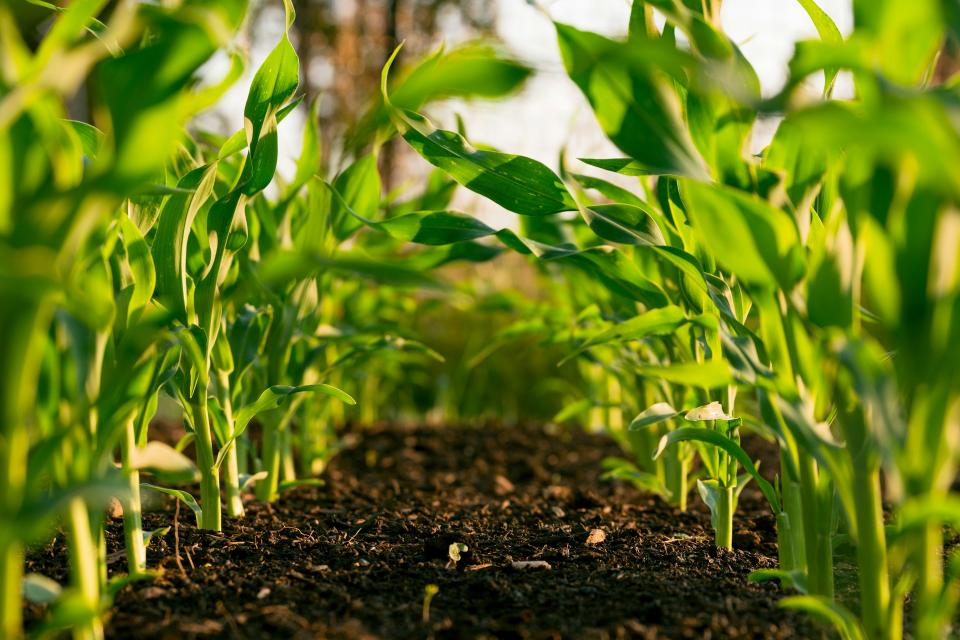
Best Companion Plants for Corn + How to Plant the Three Sisters
Quick answer: Good companion plants for corn include beans, squash, cowpeas, cucumbers, radishes, and flowering plants such as buckwheat or sweet alyssum. The best-known system is the Three Sisters—corn, beans, and squash—but it works only when spacing, timing, fertility, and corn pollination are handled correctly. Plant corn in a block rather than a single row, give it enough nitrogen and water, and do not assume that climbing beans will fertilize the corn immediately during the same season.
Corn is a very different companion crop from basil, broccoli, or lettuce. It grows tall, casts substantial shade, uses a lot of nitrogen, and depends on wind pollination. Those characteristics should determine what grows beside it.
That means the first goal is not to create the most diverse bed possible. It is to establish a healthy block of corn that can pollinate properly. Companions come second.
Best Corn Companion Plants at a Glance
| Companion | Why it can work | Best placement | Main caution |
|---|---|---|---|
| Pole beans | Can use corn as support in a Three Sisters system; legumes fix nitrogen | Added after corn is established | Young corn can be pulled down by vigorous vines |
| Bush beans | Warm-season crop with lower growth | Outside or between wide corn rows | Still compete for water and nutrients |
| Squash | Spreading leaves shade soil and suppress some weeds | Around the outside of established corn | Large vines can block access |
| Cowpeas | Heat-tolerant legume suitable beneath or around sweet corn | Between rows where space allows | Do not overplant and choke the corn stand |
| Cucumbers | Can use open ground around corn | Directed away from the corn block | Vines can tangle around stalks |
| Radishes | Fast crop that uses early-season space | Temporary gaps before corn becomes large | Harvest before heavy shading |
| Buckwheat | Flowers support beneficial insects | Nearby strip, not in the dense corn block | Can compete if allowed to grow too close |
| Sweet alyssum | Low flowers provide nectar for beneficial insects | Outside edge | May reseed freely |
Plant Corn for Pollination First
Corn is wind-pollinated. Pollen falls and blows from the tassels at the top of the plants onto the silks of developing ears. A long single row loses too much pollen to the surrounding garden, often producing ears with missing kernels.
For home gardens, plant corn in a block of at least four short rows rather than one long row. University of Minnesota Extension recommends spacing sweet corn roughly 8–12 inches apart with rows about 30–36 inches apart, depending on the variety and garden system.
Do not sacrifice the block layout simply to squeeze companion plants between every stalk. Good pollination is more important than maximizing species count.
The Three Sisters: Corn, Beans, and Squash
The Three Sisters is one of the best-known Indigenous agricultural systems in North America. Variations have been used by many Indigenous communities for centuries, with regional differences in mound shape, crop varieties, spacing, and planting sequence.
The basic arrangement combines:
- Corn: provides the tall vertical structure.
- Beans: climb the corn and form nitrogen-fixing relationships with soil bacteria.
- Squash: spreads across the soil surface, shading the ground and reducing some weed growth and moisture loss.
The concept is sound, but modern home gardeners often oversimplify it. The system works best when the right varieties and planting sequence are chosen.
Do Beans Feed Corn Nitrogen?
Legumes such as beans form nodules with nitrogen-fixing bacteria, but most of the nitrogen they fix is used by the bean plant while it is actively growing. It should not be assumed that a pole bean vine will directly fertilize neighboring corn enough to replace normal fertility management during the same season.
Some nitrogen becomes available later as roots and plant residues decompose. In practical terms, prepare the corn bed according to a soil test and fertilize the corn appropriately whether or not beans are present.
How to Plant a Three Sisters Garden
There is no single universal Three Sisters recipe because Indigenous systems vary by region and crop type. For a small home garden, use the following as a practical adaptation rather than presenting it as the one traditional method.
- Prepare fertile soil. Corn is a heavy feeder, so begin with a soil test and add nutrients according to recommendations.
- Plant the corn first. Create a block or several small clusters rather than a single row.
- Wait until the corn is established. Let stalks develop enough strength before adding climbing beans.
- Add pole beans nearby. Give each vine access to a stalk without planting so many beans that they overwhelm the corn.
- Plant squash around the outer area. Direct vines outward so they cover open soil rather than burying the corn stems.
- Keep access in mind. You still need to water, inspect, and eventually harvest all three crops.
Pole Beans
Pole beans are the classic corn companion because they can climb stalks instead of requiring a separate trellis. This saves vertical support material, but timing is important.
If beans are planted too early, vigorous vines can wrap around young corn before the stalks are strong enough. Let corn establish first, then sow the beans.
Choose a vigorous, sturdy corn variety rather than a very short or weak-stemmed sweet corn if you want the stalks to carry vines.
Bush Beans and Cowpeas
You do not need climbing beans to benefit from a legume in the same garden. Bush beans and cowpeas are easier to manage because they do not wrap around corn stalks.
University of Minnesota Extension specifically notes that cowpeas can be sown beneath sweet corn as a legume companion. In hot climates, cowpeas may fit the seasonal conditions better than cool-sensitive beans.
Leave enough room for corn roots and irrigation. Legumes are still plants with their own water and nutrient needs; they are not free fertilizer.
Squash and Pumpkins
Squash is the ground-cover component of the Three Sisters system. Large leaves shade the soil, which can reduce evaporation and suppress some weeds.
The benefit comes with a trade-off: vigorous vines can make a corn patch almost impossible to walk through. In a small garden, direct squash outward from the corn block rather than encouraging vines to weave between every stalk.
Choose a manageable variety if your bed is small. A sprawling pumpkin can travel many feet beyond the original planting area.
Cucumbers and Melons
Cucumbers and melons can use ground near corn, but they do not offer the same established cultural role as squash in a Three Sisters system. Their main benefit is spatial: they grow horizontally while corn grows vertically.
Keep vines directed away from the densest corn block so they do not interfere with watering or stalk access. If cucumbers are trellised, position the trellis so it does not create additional shade on the corn.
Radishes and Early Crops
Radishes are useful before the corn canopy becomes dense. They mature quickly and can be harvested as corn begins to shade the ground.
Lettuce can be used in the same way in cool spring weather, although it generally does not remain productive once the corn-growing season becomes hot.
This is succession planting rather than a permanent companion arrangement, but it is one of the easiest ways to get more production from the same ground.
Flowering Plants Near Corn
Flowering plants can be useful around sweet corn because they support predatory insects and parasitoids. University of Minnesota Extension notes that flowering plants such as buckwheat, cowpea, and sunn hemp have increased populations of predators and parasitoids of corn earworm in research.
Put these plants around the edge of the corn block or in a nearby insectary strip rather than allowing them to interfere with pollination, access, or fertility.
What Should You Avoid Planting Next to Corn?
Most “bad companion” lists are too absolute. There are few vegetables that become harmful merely because they are close to corn. The real problems are competition, shade, timing, and harvest access.
| Plant or situation | Why it may be a poor fit |
|---|---|
| Tomatoes immediately beside dense corn | Both are heavy feeders, and corn can shade tomatoes |
| Peppers or eggplant on the shaded side | Need strong sun for best flowering and fruiting |
| Large squash planted too densely | Can block access and compete for moisture |
| Multiple climbing vines per stalk | Can pull or twist corn, especially in wind |
| Tall sunflowers mixed into the block | Add more shade and competition around wind-pollinated corn |
| Any dense companion planting before corn is established | Can reduce early growth, pollination layout, and weed control access |
A Practical 8-by-8-Foot Corn Companion Bed
Corn needs more room than many vegetables, so an 8-by-8-foot example is more realistic than squeezing it into a narrow 4-foot bed.
- Plant at least four short rows of corn through the center of the bed.
- Space corn according to the variety, commonly around 8–12 inches within rows.
- After the corn is established, add a limited number of pole beans near selected stalks.
- Plant one or two squash plants toward outer corners and direct vines away from the center.
- Use radishes early in open spaces and harvest them before heavy shade develops.
- Plant buckwheat, alyssum, or another flowering strip just outside the main corn block.
Corn Companions Will Not Fix Poor Pollination
An ear with blank spaces or missing kernels is often a pollination problem, not a companion-planting problem. Corn needs pollen from tassels to reach every silk on the developing ear.
- Plant in blocks rather than single rows.
- Keep plants evenly watered during tasseling and silking.
- Avoid removing or damaging tassels.
- Grow enough plants for good pollen distribution.
- Isolate incompatible sweet corn types when required to preserve eating quality.
Common Corn Companion-Planting Mistakes
- Planting corn in one long row: This reduces pollination efficiency.
- Sowing climbing beans too early: Young stalks may not support vigorous vines.
- Assuming beans replace fertilizer: Corn still needs adequate fertility during active growth.
- Using too much squash: Large vines can make the bed inaccessible.
- Ignoring shade direction: Corn can substantially reduce light for crops planted on the shaded side.
- Treating one Three Sisters layout as universal: Traditional systems vary by region, crop variety, and Indigenous community.
Frequently Asked Questions
What is the best companion plant for corn?
Beans and squash are the classic companions, especially in a Three Sisters system. Cowpeas, radishes, cucumbers, and flowering plants can also fit well depending on the garden layout.
Can beans really climb corn?
Yes, but the corn should be established first. Vigorous beans planted too early can overwhelm young stalks, and very short sweet corn varieties may not provide enough support.
Do beans give nitrogen directly to corn?
Not enough to assume that corn needs no fertilizer. Beans fix nitrogen with soil bacteria, but much of that nitrogen remains in the bean plant during the growing season. More becomes available to future crops after plant residues and roots decompose.
Can tomatoes and corn grow together?
They can grow in the same garden, but both need strong sun, water, and fertility. Keep tomatoes away from the heavily shaded side of a dense corn block and provide each crop its normal spacing.
Why should corn be planted in blocks?
Corn is wind-pollinated. Several short rows create a better pollen cloud than a single long row, improving the chance that pollen reaches the silks and every kernel develops.
The Best Approach
Build the garden around corn’s pollination and fertility needs first. Plant it in a block, give it strong sun, consistent water, and adequate nitrogen, then add companions that fit around that structure.
For a Three Sisters-style garden, establish the corn first, add a manageable number of climbing beans, and direct squash outward so the system remains accessible. For a simpler garden, bush beans or cowpeas, early radishes, and a flowering border may be easier to manage.
Continue with the Vegetables, Herbs & Edible Gardening hub, or compare another companion guide in Best Companion Plants for Basil.
One Comment
Comments are closed.